Quick Clinical Summary: Should You Pick Niacinamide or Vitamin C?
When deciding between niacinamide vs vitamin c for brightening dull skin and fading dark spots, you are looking at two entirely different biological pathways: Vitamin C (pure L-ascorbic acid) tackles pigment right at the factory door by inhibiting tyrosinase—the enzyme that sparks melanin production—while also kicking collagen synthesis into gear, but its acidic nature (pH below 3.5) means it can easily sting sensitive or broken skin. On the flip side, Niacinamide (Vitamin B3) works downstream by physically stopping pigment-packed melanosomes from transferring into visible surface skin cells, while strengthening your ceramide moisture barrier and reigning in angry redness at a skin-friendly, neutral pH (5.5 to 6.5). The best clinical news? You do not have to choose just one. Research thoroughly confirms you can safely use both together to attack stubborn discoloration from both ends without causing flushing or canceling each other out.
If you have ever stood in front of a mirror comparing niacinamide vs vitamin c, you know how confusing the skincare world can get. Almost every week in my dermatology practice, patients bring me half-empty dropper bottles of both, asking the exact same question: “Dr. Waqar, which one will actually erase these dark spots faster, and will my face catch on fire if I put them on together?”
It is an understandable dilemma. Social media skincare groups and legacy beauty forums are still filled with half-baked chemistry lessons warning that mixing niacinamide and Vitamin C cancels out both ingredients or turns your skin blotchy red. Meanwhile, cosmetic brands push higher and higher percentages—15% pure ascorbic acid here, 20% niacinamide there—often leaving patients with an angry, stinging moisture barrier instead of glowing skin.
The reality is much simpler, far more interesting, and deeply rooted in how human skin cells actually process pigment. Once you understand how each active behaves inside your cells, you will see why picking one over the other is usually the wrong move—and how pairing them intelligently can transform stubborn hyperpigmentation without wrecking your lipid barrier.
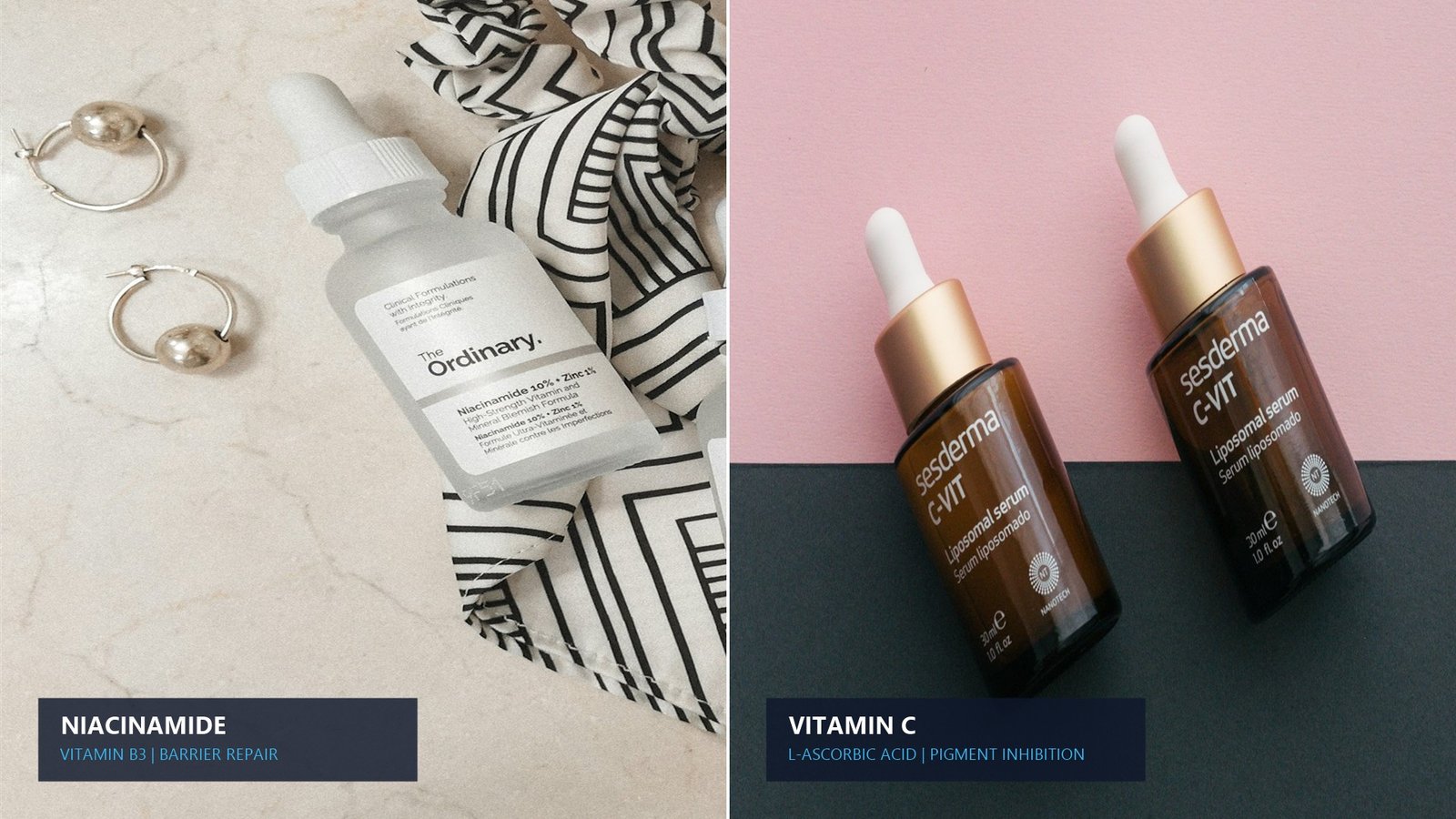
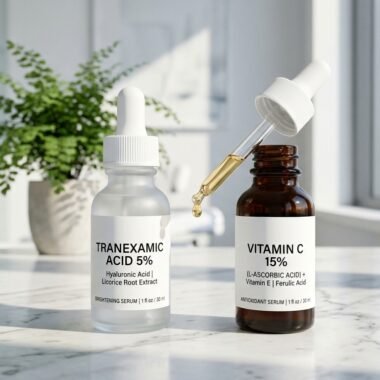
Figure 1: Real clinical cornerstones side by side: Niacinamide (Vitamin B3) and Vitamin C (L-Ascorbic Acid) serums tested in our dermatological practice.
How Pigment Actually Forms: Why One Active Is Never Enough
To understand why these two actives feel and act so differently on your face, let’s take a quick walk through your epidermis. Hyperpigmentation is not a surface stain that you can scrub off like dirt. It is the end result of an intricate, multi-step defense mechanism run by specialized cells called melanocytes, which sit quietly at the base of your epidermis.
When sunlight, inflammation from a pimple, or hormonal surges hit these melanocytes, an internal alarm bells rings. The cell calls upon a copper-dependent enzyme named tyrosinase. Think of tyrosinase as an assembly line foreman: it grabs the amino acid L-tyrosine and oxidizes it step-by-step into melanin pigment. This pigment is then packaged into tiny microscopic storage crates called melanosomes.
Once those crates are packed, the melanocyte sends them traveling up long cellular tentacle-like arms called dendrites. At the tips of these dendrites, the crates are physically handed over to neighboring skin cells (keratinocytes). As those skin cells naturally migrate to the surface over a 28-day cycle, that pigment becomes visible to your eye as a stubborn sun spot, melasma patch, or dark acne mark.
Now, here is why comparing niacinamide and Vitamin C gets fascinating: they attack completely different points of this exact assembly line.
Vitamin C: The Assembly Line Stopper
Vitamin C—specifically in its gold-standard form, L-ascorbic acid—marches right up to the assembly line foreman (tyrosinase). It binds to the copper ions inside the enzyme and donates electrons, effectively shutting down the chemical reaction before melanin polymer can ever form. If your cells cannot produce the pigment in the first place, dark spots stop spreading. On top of that, Vitamin C donates electrons to neutralise free radicals sparked by UV rays and pollution, acting like a protective forcefield over your cells during daylight hours.
If you want to see how top-tier ascorbic acid formulations perform in the real world without spending $180, take a look at our clinical testing of the best SkinCeuticals C E Ferulic dupes.
Niacinamide: The Delivery Truck Interceptor
Niacinamide (Vitamin B3) does not care about tyrosinase. In fact, research proves it does not stop the enzyme from making pigment at all. What it does instead is brilliant: it blocks the delivery trucks. In a classic clinical study led by Dr. Hakozaki and his team (PMID: 12100180), researchers proved that niacinamide cuts the transfer of melanosomes from melanocytes to surface skin cells by 35% to 68%.
Even if your melanocytes have already synthesized pigment, niacinamide traps those pigment granules inside the cellular warehouse, preventing them from ascending to the surface of your skin. Because your surface skin cells are constantly shedding, the visible skin above stays brighter, clearer, and far more uniform in tone.
Figure 2: Active delivery: Getting pure, stable antioxidants into the stratum corneum requires the right molecular balance and vehicle pH.
Dismantling the 1960s “Niacin Flush” Myth Once and for All
Let’s tackle the elephant in the room. Why did your favorite beauty guru or old Reddit thread tell you that applying niacinamide and Vitamin C together will ruin your skin? Where did this persistent myth originate?
It all traces back to a laboratory experiment conducted in the early 1960s. In that study, researchers took raw, unformulated ascorbic acid and pure niacinamide, mixed them in an unbuffered liquid solution, and heated them in an autoclave at 120°C (nearly 250°F) for several hours in high concentrations of mineral acid. Under those brutal, non-biological conditions, a tiny portion of the niacinamide broke down through acid hydrolysis into nicotinic acid (commonly known as pure niacin).
When pure nicotinic acid touches human skin, it binds to micro-vascular receptors and causes temporary blood vessel dilation. This triggers the infamous “niacin flush”—a sudden, prickling warm sensation accompanied by vivid facial redness that lasts about 20 to 30 minutes. It looks alarming, but it is actually harmless vasodilation.
Here is what the internet forgot: your bathroom counter is not a 120°C pressurized industrial autoclave. At room temperature on living human skin, the rate of niacinamide converting into nicotinic acid is so microscopically slow that it would take weeks of continuous boiling in strong acid to produce meaningful amounts. When you layer your serums at home, they simply do not convert into irritating niacin.
What about the idea that they “cancel each other out”? In concentrated test tubes, ascorbic acid and niacinamide can temporarily form a weak 1:1 hydrogen-bonded complex. But the second that complex touches your skin, the physiological moisture and lipid environment breaks those weak bonds apart immediately. Both molecules dissociate and penetrate into your skin independently, doing their respective jobs with zero loss of potency.
The Red Mark vs. Brown Mark Dilemma: PIE vs. PIH
In my clinical consultations, one of the first things I do when a patient complains about “dark spots” is examine the color under clinical dermoscopy. There is a massive clinical difference between a red or pink mark and a brown or slate-gray spot, and your active of choice must match the pathology:
Post-Inflammatory Erythema (PIE): Red or Purple Spots
If you had an angry cystic breakout three weeks ago and now have a flat pink, red, or purplish mark left behind, that is Post-Inflammatory Erythema (PIE). That mark is not melanin pigment. It is a cluster of damaged, dilated micro-capillaries near the dermal-epidermal junction that remain engorged with blood following an inflammatory flare.
The Winner for PIE: Niacinamide. Putting acidic Vitamin C (pH 3.0) on top of fragile, dilated micro-vessels can actually trigger more localized irritation and make the redness linger longer. Niacinamide, on the other hand, is a potent anti-inflammatory agent. It downregulates inflammatory cytokines like IL-8 and TNF-alpha, calms vascular hyper-reactivity, and supports capillary recovery without causing irritation.
If you are battling persistent post-acne redness alongside active papules, pairing niacinamide with medical dicarboxylic acids is unmatched; read our clinic’s breakdown on Azelaic Acid vs Tretinoin.
Post-Inflammatory Hyperpigmentation (PIH): Brown or Dark Spots
If your mark is light brown, dark brown, or slate-toned, that is true Post-Inflammatory Hyperpigmentation (PIH). Here, melanocytes overreacted to prior trauma by dumping excess melanin into the surrounding tissue. This is especially common in medium-to-deep skin tones (Fitzpatrick IV–VI).
The Winner for PIH: Vitamin C (especially paired with Niacinamide). Because PIH is driven by active melanin synthesis, Vitamin C’s ability to shut down tyrosinase works much faster at halting new pigment deposition. But when you follow it with niacinamide to stop whatever pigment was already made from spreading, the mark fades in roughly half the time compared to using either active on its own.
Head-to-Head Comparison: Niacinamide vs Vitamin C
To help you see the entire clinical landscape at a glance, here is our head-to-head dermatological comparison table:
| Clinical Parameter | Niacinamide (Vitamin B3) | Vitamin C (L-Ascorbic Acid) |
|---|---|---|
| What It Actually Is | Water-soluble B-complex vitamin amide (Nicotinamide) | Water-soluble chiral lactone antioxidant (L-Ascorbic Acid) |
| How It Fades Spots | Blocks melanosome transfer from melanocytes into skin cells | Directly inhibits tyrosinase enzyme to halt melanin creation |
| Required Formulation pH | Gentle, skin-neutral: pH 5.0 to 6.5 | Acidic: pH 2.5 to 3.5 (needed for skin penetration) |
| Impact on Moisture Barrier | Strengthens barrier; actively stimulates ceramide production | Can cause stinging, flaking, or dryness due to low pH |
| Collagen Building Power | Supports cellular energy (NAD+) and overall repair | Direct cofactor essential for prolyl and lysyl hydroxylase |
| Shelf Life & Stability | Extremely tough; unbothered by light, oxygen, or heat | Notoriously fragile; oxidizes into yellow/brown dehydroascorbic acid |
| Pores & Oil Control | Reduces sebum excretion rate by up to 30%; tightens pore look | Prevents sebum squalene oxidation that causes blackheads |
| Sweet Spot Concentration | 2% to 5% (10% is often overkill and causes irritation) | 10% to 15% (anything over 20% brings more irritation than benefit) |
| Best Matched Skin Type | Sensitive, rosacea-prone, oily, acne-prone, compromised barriers | Resilient, sun-damaged, photoaged, dull; reactive skin needs derivatives |
The Dirty Little Secret About 10% and 20% Niacinamide Serums
Here is an honest clinical reality that cosmetic marketing departments will never tell you: more is not always better.
Over the past few years, the skincare market turned into an arms race of percentages. Brands started releasing 10%, 15%, and even 20% niacinamide serums. The result in my clinic? A steady stream of patients walking in with tiny, itchy bumps along their jawline, forehead irritation, and sudden contact breakouts from a product they bought to clear their skin.
Every single peer-reviewed landmark medical trial on niacinamide—including the gold-standard research by Bissett et al. (PMID: 16029679) and Navarrete-Solís et al.—used concentrations between 2% and 5%. At 2%, niacinamide strengthens your barrier by boosting ceramide and free fatty acid synthesis. At 4% to 5%, it reaches maximum clinical efficiency for fading melasma and balancing sebum production.
Jumping to 10% or 20% does not double or quadruple your results. What it does is overwhelm the skin’s tolerance threshold, leading to irritation, localized follicular swelling, and redness. If you have ever tried a popular 10% niacinamide serum and felt it broke you out, do not write off Vitamin B3 entirely. Look for well-formulated moisturizers or serums that keep it at the sensible, clinically proven 2% to 5% sweet spot.
The Battle of Vitamin C Forms: Pure Ascorbic Acid vs. Stable Derivatives
While niacinamide is chemically rugged—you could leave a bottle in a warm car for a week and it would still work perfectly—pure Vitamin C (L-ascorbic acid) is a temperamental prima donna. It hates light, despises oxygen, and degrades in warm ambient air. Here is how the most common forms compare on your face:
1. Pure L-Ascorbic Acid (10% to 15%)
This is the biologically active form your cells immediately recognize without needing any chemical conversion. It is lightning-fast at scavenging free radicals and turning on procollagen genes. But to keep L-ascorbic acid un-ionized so it can slip past your skin’s protective lipid barrier, formulators must drop the pH down to 2.5 to 3.2. That level of acidity is roughly equivalent to lemon juice or household vinegar. If your skin barrier is compromised, dry, or prone to rosacea, it will sting, burn, and provoke inflammation.
Furthermore, once L-ascorbic acid begins turning dark yellow or orange, it has oxidized into dehydroascorbic acid. At that stage, not only has it lost its antioxidant power, but it can actually promote pro-oxidant free radical generation on your skin. If your serum smells like old hot dog water and looks like dark iced tea, throw it away.
2. Tetrahexyldecyl (THD) Ascorbate (Lipid-Soluble Vitamin C)
If you have sensitive skin or skin of color, THD ascorbate is one of the greatest advances in modern cosmetic chemistry. Because the outer layers of your skin are made of lipids (fats), water-soluble L-ascorbic acid has a hard time passing through. THD ascorbate is lipid-soluble, meaning it glides straight through your sebum and cell membranes up to 50 times deeper than regular Vitamin C.
Best of all, THD ascorbate is formulated at a soothing, neutral pH (5.5 to 6.5). Once it enters living dermal cells, your skin’s natural esterase enzymes clip off the lipid chains, releasing pure ascorbic acid right where your collagen fibroblasts live—with zero stinging, zero peeling, and zero risk of acid-induced redness.
3. 3-O-Ethyl Ascorbic Acid (EAC) & Ascorbyl Glucoside
These water-soluble derivatives are chemically shielded from oxidation. Ethyl ascorbic acid penetrates both water and oil layers rapidly, providing immediate tyrosinase suppression. Ascorbyl glucoside binds ascorbic acid to a simple glucose molecule; skin enzymes slowly cleave the sugar over several hours, providing an all-day time-release dose of antioxidants that plays exceptionally well beneath makeup and sunscreen.
For smoothing tactile rough texture alongside daytime antioxidants, explore our clinical comparison on Glycolic Acid vs Salicylic Acid.
Cellular Energetics: Why Niacinamide’s NAD+ Pathway Keeps Skin Young
Most patients know niacinamide as a dark-spot fader, but its deepest anti-aging superpower lies in mitochondrial bioenergetics. Every cell in your body requires energy to live, divide, and repair damage. That energy is generated in your cellular power plants (mitochondria) in the form of adenosine triphosphate (ATP), and the coenzyme that fuels that engine is Nicotinamide Adenine Dinucleotide (NAD+).
As we age—and especially as solar ultraviolet rays bombard our skin—our intracellular pools of NAD+ decline sharply. Depleted of energy, your skin cells become sluggish. They cannot repair UV-induced DNA photolesions, they stop making healthy ceramides, and your fibroblasts slow collagen production to a crawl. In dermatology, we call this cellular senescence.
When you apply topical niacinamide, your keratinocytes absorb it directly and run it through the cellular salvage pathway, synthesizing fresh NAD+ and NADH. This instant energetic boost fuels two crucial repair systems:
- PARP-1 DNA Repair: Poly(ADP-ribose) polymerase-1 is an emergency response enzyme that scans your genome for single-strand DNA breaks caused by sunlight. It cannot function without abundant NAD+. Niacinamide ensures PARP-1 has the fuel it needs to repair cellular damage before mutations set in.
- Sirtuin Longevity Activation: Sirtuins (specifically SIRT1) are cellular longevity proteins that turn down inflammatory genes and keep cells functioning like younger versions of themselves. Sirtuins are strictly NAD+-dependent; applying niacinamide keeps them firing on all cylinders.
Skin of Color Considerations (Fitzpatrick Types IV to VI)
Treating hyperpigmentation in melanin-rich skin requires immense clinical care. Patients with deeper skin tones have melanocytes that are inherently more reactive. The slightest physical trauma, pimple, or chemical sting can trigger an aggressive inflammatory cascade, resulting in dark, long-lasting marks that take 6 to 18 months to fade.
This is where understanding pH matters most. Applying low-pH (pH < 3.0) pure L-ascorbic acid can cause microscopic sub-clinical chemical irritation in skin of color, inadvertently provoking the very post-inflammatory hyperpigmentation you were trying to eliminate. In contrast, Niacinamide is arguably the safest active in all of dermatological pharmacology for Fitzpatrick IV–VI skin.
Because niacinamide works at a neutral pH and never injures or bleaches surrounding healthy cells, it fades hyperpigmentation without the risk of creating hypopigmented (bleached) halos. If you have deep skin and want the photoprotective benefits of Vitamin C, skip harsh 20% ascorbic acid serums and choose a non-acidic derivative like 5% to 10% THD ascorbate, or pair your niacinamide with gentle barrier-loving humectants like Hyaluronic Acid vs Polyglutamic Acid.
The Real-World Layering Protocol: How to Use Both Safely
You do not need a degree in biochemistry or a laboratory stopwatch to layer these two serums in your bathroom. Here is the step-by-step routine I prescribe to my patients who want maximum brightening without irritation:
Option 1: The Morning Power Layering Protocol (Fastest Brightening)
- Cleanse: Wash with a mild, non-foaming hydrating cleanser and pat your skin until it is completely dry.
- Apply Vitamin C First: If you are using pure L-ascorbic acid, apply 4 to 5 drops directly to dry skin. Because pure Vitamin C is formulated at an acidic pH, it needs direct contact with the stratum corneum to absorb efficiently.
- Wait 60 to 90 Seconds: You do not need to wait 20 minutes. Simply wait a minute or two until the serum dries down and feels fully absorbed. Your skin’s natural buffering capacity will immediately begin returning surface pH toward normal.
- Layer Niacinamide: Smooth 3 to 4 drops of your 2% to 5% niacinamide serum over your entire face. Niacinamide will instantly calm any tingling provoked by the Vitamin C and lock in hydration.
- Moisturize & Sunscreen: Follow with a ceramide-rich moisturizer and finish with a broad-spectrum SPF 50+ mineral sunscreen. The combination of Vitamin C, Niacinamide, and mineral zinc oxide neutralizes over 99% of solar-generated free radicals.
Option 2: The Split Routine (Best for Sensitive or Rosacea-Prone Skin)
If you have reactive skin and stacking multiple actives in one go makes you nervous, split them across your day:
- Morning Routine: Apply your Vitamin C serum beneath your sunscreen. This positions your antioxidant shield right when your face faces daytime UV rays, ozone, and blue light.
- Evening Routine: Apply your Niacinamide serum at night alongside your barrier creams or nighttime retinoids. Niacinamide works overnight to stimulate ceramide repair, soothe daytime environmental stress, and regulate sebum while you sleep.
If you are also using peptides or retinoids in your anti-aging lineup, read our clinical guide on how to safely alternate them in Copper Peptides vs Retinol.
The Clinician’s Final Verdict: Which Brightens Faster?
When all clinical trial data is laid bare, here is the honest answer to which active wins:
- Pick Vitamin C If: Your main frustration is brown sun spots, fine lines, loss of firmness, and deep photoaging, and your skin is generally resilient enough to tolerate an acidic morning active.
- Pick Niacinamide If: You have sensitive skin, rosacea, acne, or oily pores, struggle with persistent red/purple post-acne marks (PIE), or want an active that repairs your moisture barrier instead of challenging it.
- The Real Medical Secret: Combine Them. You do not have to settle for half the results. Vitamin C halts pigment creation at the factory; Niacinamide intercepts delivery to the surface. Layering both—or using Vitamin C in the morning and Niacinamide at night—is the fastest, safest, and most scientifically sound way to achieve clear, radiant, luminous skin in 2026.
For patients with stubborn melasma that resists Vitamin C, explore our clinical evaluation of Tranexamic Acid vs Vitamin C.