When comparing rosemary oil vs minoxidil 5% for androgenetic alopecia and scalp thinning, patients are caught between a clinically validated botanical vasodilator that inhibits local dihydrotestosterone (DHT) binding without systemic side effects, and an FDA-approved potassium channel opener backed by decades of dermatological trials but burdened by dread sheds and scalp irritation.
🩺 Quick Clinical Verdict: Rosemary Oil vs Minoxidil 5%
Choose Rosemary Oil (Rosmarinus officinalis) if you have a sensitive scalp prone to flaking, prefer an all-natural botanical protocol, wish to avoid the aggressive “dread shed” associated with pharmaceuticals, or are seeking a safe preventive treatment for early diffuse hair thinning. The landmark 2015 comparative clinical trial (PMID: 25842469) demonstrated that 6 months of daily rosemary oil yielded hair count increases statistically indistinguishable from 2% minoxidil with significantly less scalp itching.
Choose Minoxidil 5% (Rogaine) if you are experiencing rapidly accelerating genetic pattern hair loss (Ludwig or Norwood scale), have advanced crown or vertex miniaturization, and want the gold-standard, FDA-approved pharmaceutical treatment. Minoxidil acts faster (often showing initial regrowth at 12–16 weeks vs 24 weeks for rosemary), but requires lifelong daily adherence; discontinuing use triggers rapid shed of all regrown follicles.
The Hair Loss Epidemic: Understanding Follicular Miniaturization
In outpatient dermatology practice, few clinical consultations carry the emotional weight of progressive hair thinning. Whether a 26-year-old software engineer noticing a receding temporal hairline or a 45-year-old woman observing her central parting line gradually widen, the underlying anxiety is acute. And in roughly 85% of cases, the culprit is Androgenetic Alopecia (AGA).
Genetic pattern hair loss is not caused by hair simply “falling out”; it is driven by a microscopic pathological process termed follicular miniaturization. Under the influence of the androgen hormone dihydrotestosterone (DHT)—synthesized locally when the enzyme 5-alpha reductase converts circulating testosterone within dermal papilla cells—genetically susceptible hair follicles undergo progressive structural decline. With each successive hair growth cycle, the anagen (active growing) phase shortens from years down to months, while the telogen (resting/shedding) phase lengthens. The once robust terminal hairs shrink into fine, unpigmented vellus hairs until the follicle eventually becomes completely atrophic and fibrotic.
Stopping this biological cascades requires aggressive intervention. For over three decades, topical minoxidil reigned as the sole over-the-counter medical therapy. However, growing patient resistance to lifelong chemical dependencies, coupled with irritating side effects, has triggered intense scientific interest in botanicals—most notably comparing rosemary oil vs minoxidil.
The Molecular Mechanisms: How Each Treatment Restores Hair Follicles
To evaluate these treatments objectively, we must look beneath the scalp and analyze the distinct biochemical pathways through which each active ingredient stimulates hair follicles.
1. Minoxidil: Potassium Channel Opener & Angiogenic Catalyst
Originally developed in the 1970s as an oral antihypertensive medication for severe refractory high blood pressure, minoxidil’s hypertrichotic side effect (excessive hair growth) quickly led to its reformulation as a topical dermatological agent. Minoxidil is not an anti-androgen; it does not block DHT or suppress 5-alpha reductase. Instead, it functions as a powerful ATP-sensitive potassium ($K_{ATP}$) channel opener:
- Hyperpolarization of Vascular Smooth Muscle: When minoxidil is absorbed into the scalp, the enzyme sulfotransferase (specifically SULT1A1 in follicular outer root sheath cells) metabolizes it into its active form, minoxidil sulfate. This molecule opens potassium channels, inducing hyperpolarization of smooth muscle cells surrounding perivascular capillary loops. Arteries dilate, delivering a surge of oxygen, glucose, and systemic nutrients directly to starving follicular matrices.
- Upregulation of VEGF: Minoxidil stimulates the synthesis of Vascular Endothelial Growth Factor (VEGF), spurring localized angiogenesis (the creation of fresh capillary networks around the dermal papilla).
- Premature Anagen Induction: Minoxidil forcefully terminates the resting telogen phase, pushing dormant follicles into rapid anagen growth. This sudden biological reboot is precisely what triggers the infamous “dread shed” during the first month of treatment.
2. Rosemary Oil: Multi-Target Botanical Bioactive
Essential oil extracted from the leaves of Rosmarinus officinalis is a chemically complex phytochemical matrix consisting of dozens of terpene and phenolic compounds. The primary active constituents responsible for hair restoration are 1,8-cineole (eucalyptol), carnosic acid, and rosmarinic acid. Unlike minoxidil’s single-mechanism approach, rosemary oil operates along multiple therapeutic axes:
- Microvascular Vasodilation: Carnosic acid promotes microvascular circulation within the scalp, healing damaged nerve endings and capillary loops via tissue remodeling.
- Local Anti-Androgenic Action: Experimental trials indicate that rosemary extract inhibits 5-alpha reductase activity within follicular tissue, partially shielding androgen receptors on the dermal papilla from binding cytotoxic DHT (PMID: 22517595).
- Potent Anti-Inflammatory & Antimicrobial Defense: Scalp micro-inflammation driven by the fungal commensal Malassezia globosa (the primary trigger for seborrheic dermatitis and dandruff) exacerbates hair fall. Rosmarinic acid exerts powerful antifungal, anti-inflammatory, and antioxidant shielding, calming erythematous scalp environments where minoxidil frequently triggers irritation.
Head-to-Head Comparison: Rosemary Oil vs Minoxidil 5%
The following clinical comparison synthesizes trichological parameters, expected timelines, adverse reactions, and long-term commitments for both modalities:
The Landmark 2015 Clinical Trial: What the Science Truly Proved
The primary scientific bedrock establishing rosemary oil as a legitimate hair loss intervention is the landmark randomized, double-blind clinical trial conducted by Panahi and colleagues, published in Skinmed in 2015 (PMID: 25842469). For years, dermatologists routinely dismissed botanical claims as internet folklore; this trial forced the medical establishment to take notice.
The researchers enrolled 100 male and female patients diagnosed with confirmed androgenetic alopecia. The cohort was divided into two rigorously monitored groups for a full 6-month duration:
- Group A: Applied 1 mL of standardized rosemary oil lotion twice daily.
- Group B: Applied 1 mL of pharmaceutical minoxidil 2% solution twice daily.
Dermatologists performed standardized micro-photographic hair counts at baseline, month 3, and month 6. The trial produced several remarkable findings:
- Month 3 Showed Zero Regrowth in Both Groups: Crucially, at the 3-month midpoint, neither group showed any statistically significant increase in hair counts compared to baseline. This demonstrates that any patient who abandons either treatment at 8 to 12 weeks thinking “it doesn’t work” is aborting therapy before biological follicular remodeling can physically occur.
- Month 6 Achieved Equal Clinical Superiority: At the 6-month evaluation, both the rosemary oil group and the minoxidil 2% group experienced a statistically significant increase in total hair count compared to baseline. Most critically, there was no statistically significant difference between the hair count gains of the two groups. Rosemary oil stood toe-to-toe with the pharmaceutical control.
- The Pruritus (Itching) Divergence: While clinical efficacy was identical, side effect tolerability was not. The minoxidil group reported significantly higher rates of scalp itching (pruritus), erythema, and flaking compared to the rosemary oil cohort. The botanical solution proved markedly gentler on the scalp barrier.
The Feared “Minoxidil Dread Shed”: Why It Occurs & How to Survive It
In clinical practice, the single most common reason patients quit minoxidil within the first six weeks is acute telogen shedding—frequently termed the “dread shed” across hair loss communities. Patients start treatment hoping to gain hair, only to watch clumps fall out into their hairbrushes two weeks later, triggering sheer panic.
It is vital to understand the underlying physiology: the dread shed is actually a clinical indicator that minoxidil is working. When minoxidil hyperpolarizes follicular cells, it forcefully kicks resting telogen hairs out of their follicles to initiate an accelerated anagen growth phase. The old, miniaturized hair shaft must be shed before a thicker, healthier terminal hair can emerge from the same follicular pore.
This shed typically begins around week 2 to week 4 and subsides by week 6 to week 8. If you can endure this turbulent transition, robust regrowth usually emerges by month 4. However, for emotionally distressed patients who cannot tolerate accelerated hair loss, rosemary oil represents a dramatically calmer alternative: because its vasodilatory and DHT-inhibiting actions build gradually, acute telogen shedding is exceedingly rare.

Formulation Chemistry: How to Dilute Rosemary Oil Safely
One of the most dangerous mistakes circulating on social media platforms like TikTok is the direct application of 100% pure rosemary essential oil straight onto the scalp. Pure essential oils are highly concentrated volatile botanical distillates; unbuffered application triggers severe contact dermatitis, chemical burns, epidermal desquamation, and paradoxically exacerbates hair loss by inflaming follicular ostia.
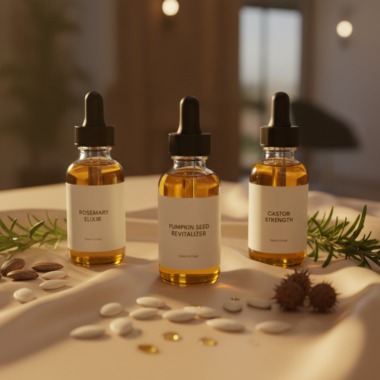
To replicate the safety and efficacy demonstrated in clinical trials, rosemary essential oil must always be diluted into a compatible carrier oil at a 2% to 3% concentration:
- The Ideal Carrier Bases:
- Jojoba Oil: Structurally mirrors natural human sebum, absorbs rapidly, and does not leave an overly greasy residue on fine hair shafts.
- Pumpkin Seed Oil: A clinical powerhouse in its own right. Clinical trials (PMID: 24864150) demonstrate that pumpkin seed oil inhibits 5-alpha reductase, delivering synergistic anti-DHT action when paired with rosemary.
- Argan Oil: Rich in oleic and linoleic fatty acids and vitamin E, ideal for dry, brittle, or chemically processed hair.
- The Exact Dermatological Recipe (2.5% Concentration):
- Take 30 mL (1 fluid ounce) of your chosen carrier oil.
- Add exactly 15 to 18 drops of 100% pure, therapeutic-grade Rosmarinus officinalis essential oil.
- Invert and shake gently in an amber glass dropper bottle to protect the bioactives from photolytic oxidation.
- Pre-Made Alternatives: If compounding at home is inconvenient, commercially prepared products like Mielle Organics Rosemary Mint Scalp & Hair Strengthening Oil provide accessible, pre-diluted options ($10.00 / £9.00 at Target, Ulta, or Boots UK).
Can You Combine Both? (Dr. Waqar’s Hybrid Protocol)
Patients frequently ask: “Doctor, why must I choose? Can I use both rosemary oil and minoxidil together?”
The clinical answer is a resounding yes—provided you space them apart correctly. Never mix liquid minoxidil and rosemary oil in the palm of your hand simultaneously, as the oily lipid barrier of the carrier oil will severely impede the water/alcohol-based minoxidil from penetrating into follicular outer root sheaths.
The Daily Stacking Schedule:
- Morning Protocol (Minoxidil Foam 5%): Apply half a capful of 5% minoxidil foam to dry, clean scalp areas. The foam vehicle dries within 10 to 15 minutes, leaves zero greasy residue, and provides continuous potassium channel stimulation throughout the working day without disrupting hair styling.
- Evening Protocol (Rosemary Botanical Oil): Three to four evenings per week, apply 1 mL to 2 mL of your diluted rosemary-pumpkin seed oil blend to the scalp 2 hours before bed (or leave it on for 60 minutes before washing out). Gently massage with fingertips or a silicone scalp massager for 4 minutes to promote mechanical shear stress, which further upregulates follicular Wnt/beta-catenin signaling pathways.
Crucial Safety Warnings & Contraindications
Before initiating either hair restoration regimen, several vital safety parameters and medical contraindications must be understood:
- The Fatal Pet Toxicity of Minoxidil: Minoxidil is exceptionally lethal to feline pets and toxic to canines. Cats lack the specific glucuronyl transferase liver enzyme required to metabolize minoxidil; even microscopic exposure (such as a cat licking a pillowcase where minoxidil was applied, or brushing against wet hair) can cause fatal heart failure and pulmonary edema within hours. If you share a home with cats, either switch exclusively to rosemary oil or utilize minoxidil foam strictly in the morning, washing hands thoroughly with soap.
- Pregnancy & Nursing Warnings: Minoxidil is an FDA Category C medication; it crosses the placenta, enters breast milk, and carries risks of fetal developmental abnormalities. Pregnant or breastfeeding women must strictly avoid minoxidil. Rosemary essential oil in high concentrated doses is also an emmenagogue (stimulating uterine blood flow) and should be avoided during pregnancy without obstetrician clearance.
- Cardiovascular Effects of Minoxidil: In roughly 2% of patients, topical minoxidil absorbs systemically, causing orthostatic hypotension, reflex tachycardia, palpitations, dizziness, or peripheral fluid retention (puffy ankles). If you have pre-existing cardiovascular conditions, consult your cardiologist before initiating treatment.
- The Lifelong Dependency Trap: Minoxidil does not cure androgenetic alopecia; it temporarily bypasses it. If you use minoxidil for three years, achieve wonderful hair density, and then stop, all hairs maintained by the medication will enter an accelerated shedding phase within 12 to 16 weeks, reverting your scalp to where it would have been had you never started.
Frequently Asked Questions: Rosemary Oil vs Minoxidil
Final Trichological Verdict: Which Restorative Agent Wins?
When weighing rosemary oil vs minoxidil, there is no one-size-fits-all prescription. Your choice should align precisely with your stage of hair thinning, your lifestyle preferences, and your tolerance for potential side effects:
- Choose Rosemary Oil: If you are experiencing early diffuse thinning, post-stress telogen effluvium, have sensitive skin prone to dermatitis, live with feline pets, or want an all-natural, side-effect-free therapy that supports scalp microbiome health without pharmaceutical commitment.
- Choose Minoxidil 5%: If you are battling established, aggressive genetic pattern baldness, need rapid terminal hair stabilization, and are fully committed to lifelong twice-daily adherence.
- The Modern Hybrid Winner: For the ultimate non-invasive protocol, combine morning minoxidil 5% foam with 3-times-weekly evening rosemary and pumpkin seed scalp massages. This pairs pharmaceutical potassium channel hyperpolarization with botanical anti-inflammatory microvascular support for maximum follicular density.
⚕️ Medical Disclaimer & Clinical Study Citations
The information contained in this trichological review is intended strictly for educational and informational purposes and does not constitute formal medical diagnosis or clinical treatment. Hair loss can be symptomatic of underlying systemic pathologies (such as thyroid disorders, ferritin deficiency, or autoimmune alopecia areata). Consult a board-certified dermatologist or trichologist for personalized diagnostic evaluation before initiating treatment.
- Panahi Y, et al. “Rosemary oil vs minoxidil 2% for the treatment of androgenetic alopecia: a randomized comparative trial.” Skinmed, 2015. PMID: 25842469.
- Murata K, et al. “Promotion of hair growth by Rosmarinus officinalis leaf extract.” Phytother Res, 2013. PMID: 22517595.
- Cho YH, et al. “Effect of pumpkin seed oil on hair growth in men with androgenetic alopecia: a randomized, double-blind, placebo-controlled trial.” Evid Based Complement Alternat Med, 2014. PMID: 24864150.
- Badri T, et al. “Minoxidil.” StatPearls Publishing, 2023. PMID: 30252329.