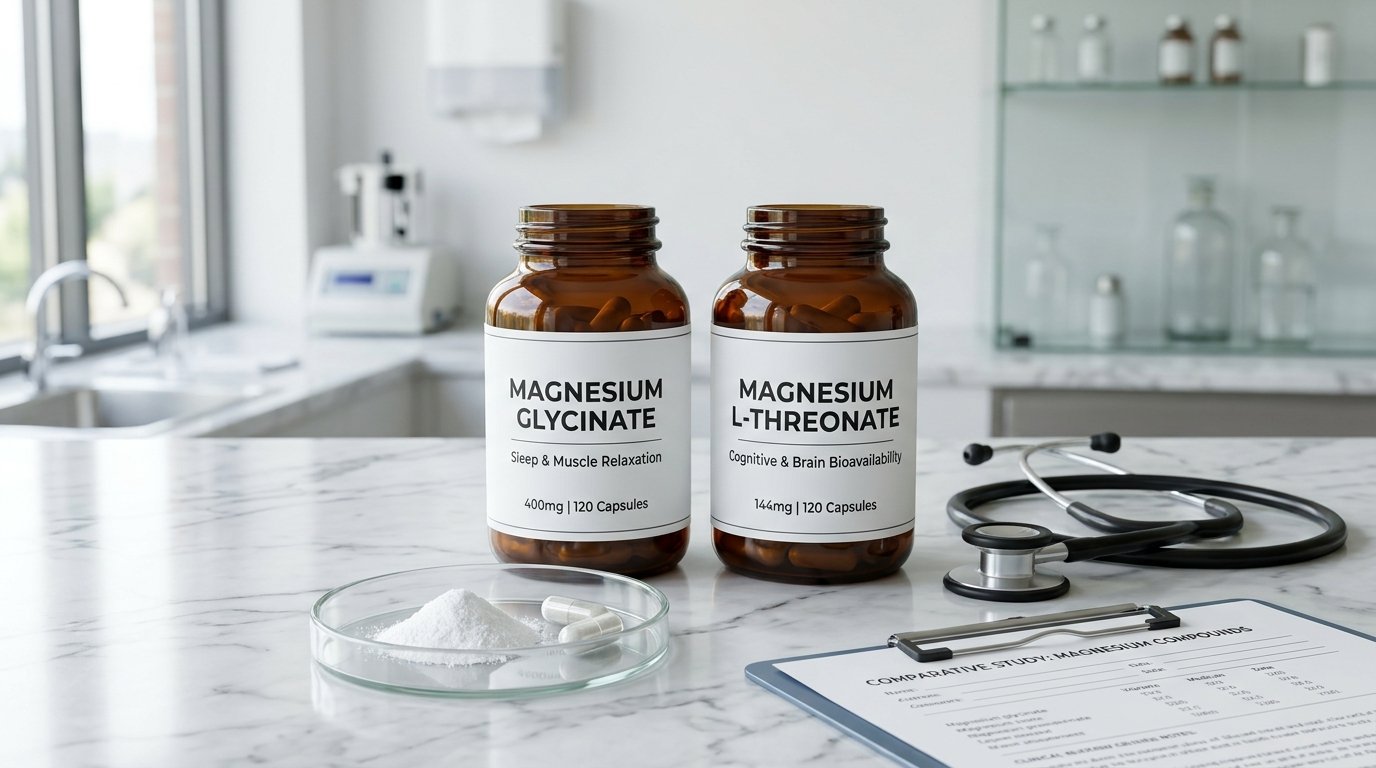
When evaluating magnesium glycinate vs magnesium l-threonate, the critical clinical distinction boils down to where the mineral actually travels inside your physiology: whether you need deep peripheral muscular relaxation and restorative slow-wave sleep, or targeted blood-brain barrier penetration to enhance synaptic density, executive memory, and acute cognitive stamina.
🩺 Quick Clinical Verdict: Magnesium Glycinate vs Magnesium L-Threonate
Choose Magnesium Glycinate if your primary struggles are physical anxiety, muscle tension, nocturnal cramps, fibromyalgia, or falling asleep. Glycine acts as an inhibitory neurotransmitter in the brainstem and spinal cord, inducing systemic peripheral calm at an accessible cost ($0.25–$0.40 per day).
Choose Magnesium L-Threonate (Magtein) if you are combating brain fog, age-related memory decline, chronic migraines, or ADHD-related executive dysfunction. L-threonate is the only chelated compound clinically demonstrated to cross the blood-brain barrier effectively and elevate cerebrospinal fluid magnesium concentrations by 15% (PMID: 20152124), albeit at a higher premium ($1.10–$1.60 per day).
The Clinical Dilemma: Why 75% of Adults Are Functionally Deficient
In outpatient clinical practice, barely a day passes without a patient sitting across from me describing a familiar triad of modern physiological exhaustion: unrestorative sleep, persistent muscular tightness around the trapezius and jaw, and an alarming sensation of cognitive sluggishness—frequently labeled as “brain fog.” When blood panels arrive, total serum magnesium almost invariably sits in the “normal” range (typically 1.8 to 2.2 mg/dL). Yet, this lab value represents one of the most persistent diagnostic traps in conventional healthcare.
Total serum magnesium accounts for less than 1% of your body’s total magnesium stores; roughly 99% resides intracellularly within your skeletal bone matrix (60%), muscle tissue (20%), and soft organ tissues (19%). An individual can suffer from severe intracellular and neuronal depletion while maintaining completely unremarkable serum levels, as the endocrine system leaches bone reserves to preserve cardiovascular homeostasis. With modern industrial agriculture depleting soil minerals by over 30% over the last half-century, relying entirely on dietary intake has become exceedingly difficult.
However, simply walking into a pharmacy and purchasing any generic bottle labeled “Magnesium” is equally counterproductive. Ingesting cheap inorganic salts like magnesium oxide delivers an elemental absorption rate of roughly 4%, primarily functioning as an osmotic laxative rather than replenishing cellular reserves. The real therapeutic power lies in targeted amino acid chelation: specifically comparing magnesium glycinate vs magnesium l-threonate.
Molecular Physiology: Elemental Magnesium vs The Carrier Molecule
To understand the fundamental therapeutic divergence between these two compounds, we must examine chelation biochemistry. Elemental magnesium ($Mg^{2+}$) is a divalent cation carrying a strong positive electrical charge. In its raw ionic state, it readily binds to water molecules and mucosal lining proteins within the small intestine, triggering osmotic diarrhea before it can cross into the bloodstream.
Chelation solves this biological bottleneck by chemically bonding the elemental magnesium ion to an organic carrier molecule via coordinate covalent bonds. This shields the mineral’s electrical charge, allowing it to navigate the stomach’s acidic environment intact and absorb through dipeptide and amino acid transport channels in the jejunum rather than competing for overwhelmed mineral ion transporters.
1. Magnesium Bisglycinate: The Dual-Action GABAergic Calmer
Magnesium glycinate (properly termed magnesium bisglycinate) binds one elemental magnesium atom between two molecules of glycine, the smallest and simplest non-essential amino acid. Glycine is not merely an inert carrier vehicle; it is an inhibitory neurotransmitter that readily crosses into the central nervous system. Glycine acts synergistically with magnesium by binding to NMDA receptor complexes and glycine receptors in the spinal cord and brainstem, down-regulating sympathetic nervous system firing and promoting peripheral vasodilation.
2. Magnesium L-Threonate: The Blood-Brain Barrier Specialist
Magnesium L-threonate (patented under the brand name Magtein) binds elemental magnesium to L-threonic acid, a four-carbon chiral sugar acid metabolite of vitamin C. Developed by a team of neurobiologists at the Massachusetts Institute of Technology (MIT), this specific chelate was engineered to solve a long-standing neurological puzzle: the blood-brain barrier is notoriously impermeable to standard divalent mineral cations.
L-threonate acts as an active molecular escort. By leveraging specialized monocarboxylate transporters lining cerebral endothelial microvessels, it drives elemental magnesium across the blood-brain barrier and directly into neural tissue, fundamentally shifting cerebrospinal fluid magnesium concentrations in a manner no other oral compound can replicate.
Head-to-Head Comparison: Magnesium Glycinate vs Magnesium L-Threonate
To assist in your clinical decision-making, the following table synthesizes pharmacokinetics, elemental yields, primary clinical indications, and financial realities for both therapeutic agents:
The Blood-Brain Barrier Mystery: What the MIT Research Proved
To grasp why magnesium L-threonate created an international research sensation, one must examine the seminal study published by Slutsky and colleagues from MIT in Neuron (PMID: 20152124). For decades, neuroscientists recognized that magnesium plays an essential role as a natural plug for the N-methyl-D-aspartate (NMDA) receptor. Without adequate magnesium sitting inside the receptor channel, calcium rushes into neurons unabated, causing chronic excitotoxicity, synaptic deterioration, and eventual cell death.
However, when researchers administered standard oral magnesium compounds (such as magnesium chloride, citrate, or gluconate) to animal models, even massive serum elevations resulted in negligible shifts in cerebrospinal fluid (CSF) magnesium levels. The choroid plexus and endothelial tight junctions strictly regulate the brain’s internal electrolyte milieu, actively pumping excess circulating magnesium back into peripheral circulation.
Magnesium L-threonate shattered this biological ceiling. The MIT researchers discovered that L-threonate not only penetrated the blood-brain barrier cleanly, but it also elevated brain extracellular magnesium concentrations by approximately 15% within 24 days. More astonishingly, this targeted elevation triggered measurable functional transformations in neuroanatomy:
- Enhanced Synaptic Density: Marked increases in functional synaptic connections in both the hippocampus (the brain’s memory-encoding center) and the prefrontal cortex (responsible for executive planning and focus).
- Up-regulation of NR2B Subunits: An increase in specific NMDA receptor subunits that govern long-term potentiation (LTP)—the fundamental biological mechanism of learning.
- Reversal of Brain Aging: In subsequent randomized, double-blind human clinical trials published in the Journal of Alzheimer’s Disease (PMID: 26518018), 12 weeks of magnesium L-threonate supplementation reversed clinical cognitive performance deficits by the equivalent of 9 years of biological aging.
Deep Dive: Magnesium Glycinate for Sleep Architecture & Nervous System Regulation
While magnesium L-threonate reigns supreme in synaptic density, dismissing magnesium glycinate would be a grave clinical error. In clinical practice, magnesium bisglycinate remains my front-line recommendation for insomnia, restless leg syndrome, fibromyalgia, and somatic manifestations of generalized anxiety disorder.
The secret lies in the glycine payload. When you consume a therapeutic 400mg dose of elemental magnesium from a high-purity bisglycinate chelate, you are simultaneously delivering approximately 2,800mg of free amino acid glycine into your portal circulation. Glycine exerts profound neurological and thermoregulatory effects:
- Core Body Temperature Reduction: Glycine stimulates vasodilation in peripheral blood vessels (particularly in the hands and feet). By directing blood flow to the extremities, it naturally drops core body temperature by 0.5°F to 1.0°F. Core temperature drop is the physiological trigger required for your brain to initiate melatonin release and enter slow-wave sleep (PMID: 25533534).
- Stage 3 and Stage 4 Slow-Wave Sleep (NREM): Polysomnography studies indicate that glycine ingestion significantly shortens sleep latency (the time it takes to fall asleep) and elongates the duration of deep slow-wave sleep without altering REM cycles or causing the next-day hangover associated with pharmaceutical hypnotics like zolpidem or benzodiazepines.
- Direct Muscular Spasmolysis: At the neuromuscular junction, magnesium competes directly with calcium ions. Where calcium triggers actin-myosin contraction, magnesium acts as a muscle relaxant by allowing the sarcoplasmic reticulum to reabsorb calcium. For patients suffering from nighttime calf spasms, restless legs, or tension headaches originating from tight suboccipital muscles, glycinate delivers rapid systemic relief.

The “Label Math” Trap: Elemental Yield vs Total Compound Weight
One of the most frequent points of confusion among patients in my clinic stems from supplement bottle label deception. Consumers often read the front of a bottle stating “2,000mg Magnesium L-Threonate” and assume they are consuming an enormous mega-dose of mineral. This is biochemically false.
You must always examine the “Supplement Facts” panel on the reverse of the bottle and distinguish between Total Compound Weight and Elemental Magnesium:
- Magnesium L-Threonate Math: Pure Magtein contains roughly 7.2% to 8% elemental magnesium by molecular weight. Therefore, a standard daily therapeutic dose of 2,000mg of Magnesium L-Threonate delivers precisely 144mg of elemental magnesium. The remaining 1,856mg consists of the threonic acid carrier molecule. While 144mg is scientifically optimized for brain CSF concentration, it only satisfies roughly 35% of an adult male’s daily recommended allowance (RDA) of 400–420mg.
- Magnesium Glycinate Math: Pure, fully reacted magnesium bisglycinate contains approximately 14.1% elemental magnesium by molecular weight. To achieve 200mg of elemental magnesium, you ingest roughly 1,418mg of total chelated compound. To achieve 400mg, you need roughly 2,836mg.
- The “Buffered” Glycinate Scandal: Beware of cheap brands that cut costs by selling “buffered” magnesium glycinate. These manufacturers blend a small amount of real glycinate with cheap magnesium oxide to artificially inflate the elemental number on the label. If a tiny capsule claims to provide 250mg of elemental magnesium as pure glycinate, it is chemically impossible without the inclusion of hidden oxide. Look specifically for “100% Unbuffered Non-GMO TRAACS Magnesium Bisglycinate Chelate” (Albion minerals).
Clinical Dosage, Circadian Timing & Stacking Protocols
Rather than viewing these two premier compounds as fierce competitors, modern functional neurology increasingly combines them into an optimized circadian protocol. Depending on your personal pathology, here is how I structure clinical regimens:
Protocol A: The Cognitive Focus & Executive Function Regimen
Primary Goal: Eliminating brain fog, improving working memory, and shielding against neurodegenerative decline.
- Morning (with breakfast): Take 1 capsule of Magnesium L-Threonate (delivering approximately 48mg elemental magnesium). This gently raises brain extracellular magnesium during peak executive work hours without causing drowsiness.
- Early Afternoon (around 2:00 PM): Take a second capsule of Magnesium L-Threonate (48mg elemental) to stave off mid-afternoon cognitive fatigue.
- Night (1 hour before bed): Take the third capsule of Magnesium L-Threonate (48mg elemental) to facilitate nighttime synaptic remodeling and consolidation.
Protocol B: The Severe Insomnia & High-Cortisol Anxiety Regimen
Primary Goal: Calming an overstimulated sympathetic nervous system, stopping racing thoughts in bed, and easing physical muscle tension.
- Evening (with dinner): Take 200mg of elemental Magnesium Bisglycinate to begin skeletal muscle relaxation and initiate peripheral vasodilation.
- Bedtime (45 minutes prior to sleep): Take an additional 200mg of elemental Magnesium Bisglycinate with a small cup of chamomile or tart cherry juice (which naturally contains phytomelatonin). Total elemental dose: 400mg.
Protocol C: The Ultimate “Neuro-Somatic” Stack (Dr. Waqar’s Preferred Formula)
For patients who suffer from both daytime cognitive fatigue and nighttime sleep architecture disruption, combining both compounds yields synergistic clinical superiority:
- Morning: 1,000mg Magnesium L-Threonate (delivering 72mg elemental magnesium to the central nervous system for sharp focus).
- Night (60 mins before bed): 1,000mg Magnesium L-Threonate + 200mg Elemental Magnesium Bisglycinate. This strategy simultaneously saturates hippocampal NMDA receptors while delivering 1,400mg of calming glycine to reduce core body temperature and induce restorative slow-wave sleep.
Gastrointestinal Safety & Side Effect Profiles
One of the greatest fears patients harbor regarding magnesium supplementation is gastrointestinal distress. Anyone who has mistakenly consumed magnesium citrate or oxide is well acquainted with sudden, cramp-inducing osmotic diarrhea. Does this risk apply to glycinate or L-threonate?
The short clinical answer is: No, provided the formulation is non-buffered. Because both glycinate and L-threonate are protected by strong organic chelate bonds, they absorb intact through the intestinal wall rather than remaining trapped inside the intestinal lumen where they would draw water via osmosis. In clinical trials, magnesium glycinate demonstrates an adverse gastrointestinal event rate of less than 1.5% at standard 400mg doses.
However, magnesium L-threonate does carry a unique, mild side effect in roughly 5% of first-time users: transient daytime somnolence or a mild “pressure headache” during the first 3 to 5 days of initiation. This occurs because the sudden influx of magnesium across the blood-brain barrier alters cerebral vascular resistance and microvascular tone. This sensation resolves spontaneously if the initial dose is titrated upward gradually over two weeks.
Tier-1 Buyer’s Guide: Sourcing Verified Formulations in the US, UK & Canada
The dietary supplement marketplace in North America and Western Europe is notoriously unregulated; third-party analytical audits consistently reveal that over 30% of commercial magnesium supplements fail to meet their stated label claims or contain unreacted, cheap raw materials. When purchasing either compound, insist on rigorous quality verifications:
1. What to Look for When Buying Magnesium L-Threonate
Always verify that the bottle contains genuine Magtein®. Magtein is the proprietary, clinically validated compound patented by Magceutics and extensively researched by MIT. Reputable premium brands in the United States, UK, and Europe license authentic Magtein:
- Life Extension Neuro-Mag: The benchmark clinical formulation, widely available across the US and UK ($32.00 / £28.00 for a 30-day supply).
- NOW Foods Magtein: Excellent value-to-purity ratio, third-party tested with Informed-Choice certification ($36.00 for 90 vegetarian capsules).
- Cymbiotika Liposomal Magnesium L-Threonate: A premium liquid liposomal pouch delivery designed for enhanced sublingual and mucosal bioavailability, ideal for patients with malabsorption syndromes ($62.00 per month).
2. What to Look for When Buying Magnesium Glycinate
Avoid any product stating “Magnesium Glycinate (buffered with Magnesium Oxide)”. Seek out 100% pure, unbuffered TRAACS® (The Real Amino Acid Chelate System) certified by Albion Laboratories:
- Thorne Magnesium Bisglycinate: The gold standard in medical-grade purity. Powdered form sweetened lightly with monk fruit, NSF Certified for Sport ($44.00 for 60 servings).
- Pure Encapsulations Magnesium (Glycinate): Hypoallergenic, manufactured without artificial fillers, magnesium stearate, or gluten ($26.00 for 90 capsules).
- Doctor’s Best High Absorption Magnesium: Highly accessible, cost-effective pure TRAACS chelates ($17.00 for a 2-month supply).
Frequently Asked Questions: Magnesium Glycinate vs L-Threonate
Final Medical Verdict: Making the Right Therapeutic Investment
In medical biochemistry, there is rarely a universal “best” molecule—only the best molecule for your specific physiological objective. When choosing between magnesium glycinate vs magnesium l-threonate, let your dominant symptoms guide your decision:
- Opt for Magnesium Glycinate: If you are primarily battling unrefreshing sleep, elevated cortisol, nocturnal muscle cramps, somatic anxiety, or tension headaches. It is safe, exceptionally well-tolerated, delivers high elemental magnesium yields, and remains affordable for long-term daily health maintenance.
- Opt for Magnesium L-Threonate (Magtein): If your central challenges revolve around brain fog, attention fatigue, short-term memory lapses, migraine frequency, or post-concussive recovery. Its unique ability to elevate cerebrospinal fluid magnesium concentrations makes it an indispensable neuro-protective tool.
If budget permits, combining both—taking 1,000mg of L-threonate during morning deep work hours and 200mg–400mg of elemental bisglycinate prior to bed—delivers the most comprehensive, 24-hour neuro-somatic support modern functional medicine can offer.
⚕️ Medical Disclaimer & Clinical Study References
The information provided in this review is for educational and informational purposes only and does not substitute for personalized medical advice, diagnosis, or clinical treatment from a licensed physician. Always consult your doctor or healthcare provider before initiating any new supplement protocol, particularly if you have kidney disease, bradycardia, or take prescription medications.
- Slutsky I, et al. “Enhancement of Learning and Memory by Elevating Brain Magnesium.” Neuron, 2010. PMID: 20152124.
- Liu G, et al. “Efficacy and Safety of MMFS-01, a Synapse Density Enhancer, for Treating Cognitive Impairment in Older Adults: A Randomized, Double-Blind, Placebo-Controlled Trial.” J Alzheimers Dis, 2016. PMID: 26518018.
- Kawai N, et al. “The Sleep-Promoting and Hypothermic Effects of Glycine are Mediated by NMDA Receptors in the Suprachiasmatic Nucleus.” Neuropsychopharmacology, 2015. PMID: 25533534.
- Boyle NB, et al. “The Effects of Magnesium Supplementation on Subjective Anxiety and Stress—A Systematic Review.” Nutrients, 2017. PMID: 28445426.