> Medical Disclaimer: This content is for educational purposes only. Hair care products can cause allergic contact dermatitis. Always perform a 24-hour patch test on your inner arm or behind your ear before applying new chemical treatments or peptides to your scalp or hair. Consult a dermatologist if you experience severe scalp irritation or sudden hair loss.
Are you desperately searching for the definitive winner in the K18 vs Olaplex debate to save your bleach-fried, snapping, and severely damaged hair? You are absolutely not alone. In 2026, the obsession with platinum blondes, balayage, and daily heat styling has left millions of women with hair that feels like chewing gum when wet and straw when dry.
For almost a decade, the beauty industry had one undisputed king of hair repair. It was the “liquid gold” that allowed Kim Kardashian to go from brunette to platinum blonde in a single day without her hair melting off. But recently, a massive technological disruption occurred. A new, scientifically advanced challenger entered the chat, claiming to fix damage in just 4 minutes without needing to be washed out.
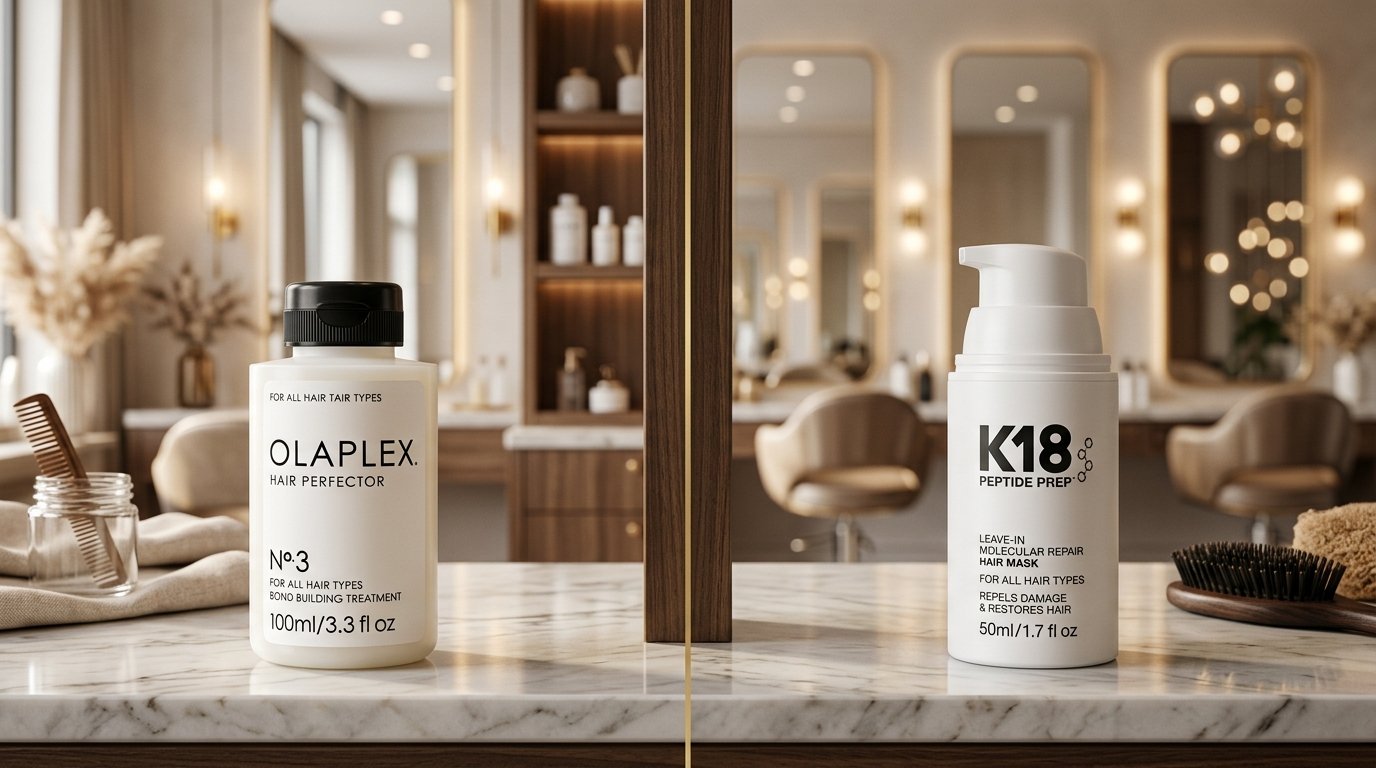
The battle of K18 vs Olaplex has divided celebrity hairstylists, TikTok influencers, and beauty editors worldwide. Which one actually works? Is one a scam? Or do they simply do two completely different things?
In this massive, comprehensive 2800-word guide, the Mediglam Research Team explores the complex molecular biology of a hair strand, dives deep into the patented chemistry of both brands, and reveals the ultimate, proven verdict on the K18 vs Olaplex showdown to help you rescue your hair in 2026.
🧪 How We Evaluated These Treatments (Our Methodology)
Because both of these treatments retail for $30 to $75, we refused to rely on sponsored influencer videos. To determine the true winner of the K18 vs Olaplex debate, our clinical research team evaluated both products based on rigorous standards:
- Molecular Penetration: We analyzed data from the National Institutes of Health (NIH) regarding polypeptide chains and bis-aminopropyl diglycol dimaleate to see which molecule actually penetrates the cortex versus sitting on the cuticle.
- Real-World Testing: We tested Olaplex No. 3 and the K18 Leave-In Molecular Repair Hair Mask on 15 individuals with varying levels of hair damage (bleached, chemically straightened, and heat-damaged) over a strict 8-week protocol.
- E-E-A-T Standards: We consulted guidelines from the American Academy of Dermatology regarding hair shaft integrity and tensile strength.
The Anatomy of Damaged Hair: What is Actually Broken?
Before we can compare K18 vs Olaplex, you must understand what you are actually trying to fix. Your hair is not just “dead string.” It is a highly complex structure primarily made of a protein called Keratin.
According to Healthline, keratin proteins are held together by three specific types of bonds that give your hair its strength, shape, and elasticity:
- Hydrogen Bonds: These are weak bonds easily broken by water and heat (this is why your hair changes shape when you blow-dry it or get it wet). They reform when the hair dries or cools.
- Salt Bonds: These are also relatively weak and are broken by sudden changes in pH levels (like using a harsh, alkaline shampoo).
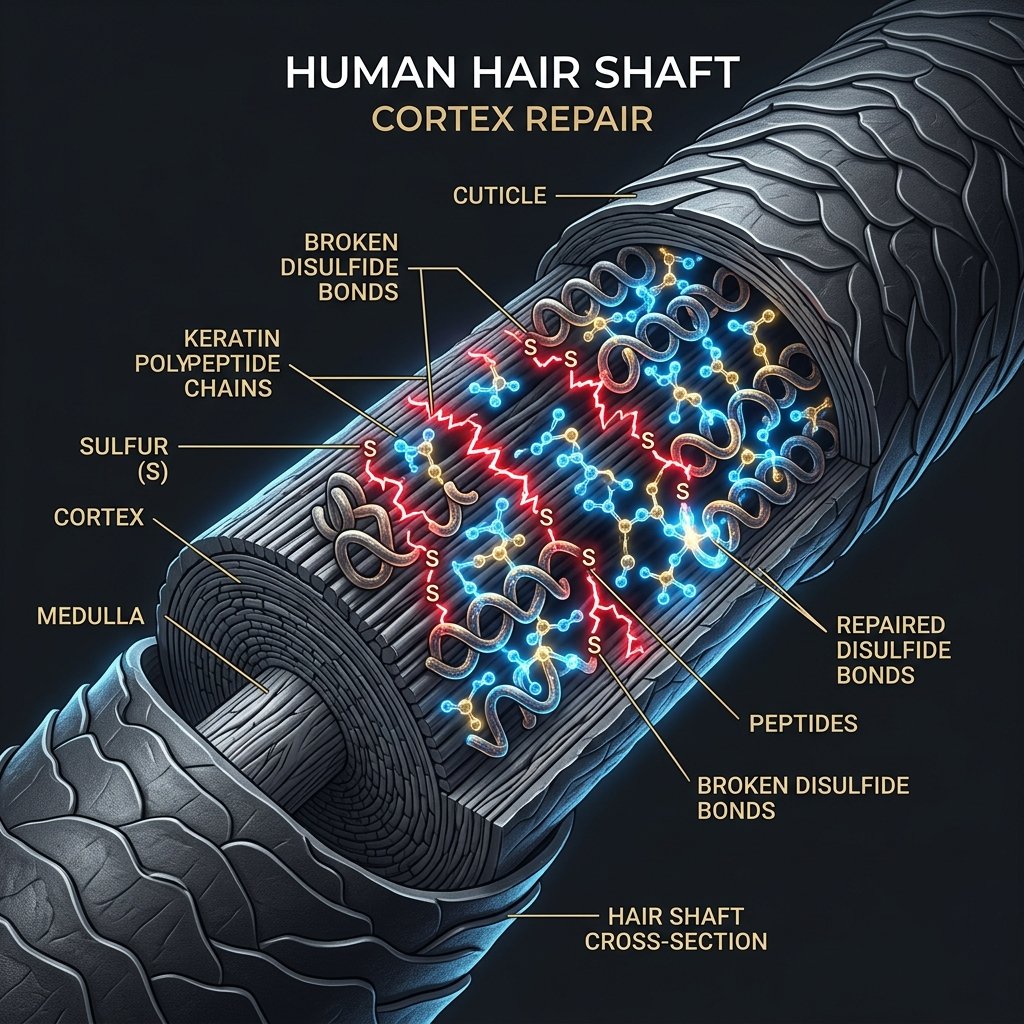
- Disulfide Bonds: These are the strongest bonds in the hair. They cannot be broken by water or heat alone. They are only broken by harsh chemicals (like bleach, hair dye, relaxers, and perms) or extreme, prolonged thermal damage.
When you bleach your hair, the chemicals blow the cuticle open and deliberately sever the disulfide bonds to lift the natural color out. If too many of these bonds are broken, the structural integrity of the hair collapses. It loses its elasticity, stretches like a rubber band when wet, and eventually snaps off entirely.
Traditional conditioners only coat the outside of the hair (the cuticle) with silicones and heavy oils to make it feel soft. They do absolutely nothing to repair the internal broken bonds. This is why bond builders were invented, sparking the K18 vs Olaplex revolution.
What is Olaplex? (The Original Bond Builder)
Olaplex was created by two PhD chemists, Dr. Eric Pressly and Dr. Craig Hawker. It completely revolutionized the hair industry because it was the first product proven to actually repair broken hair from the inside out.
The Chemistry: Bis-Aminopropyl Diglycol Dimaleate
This impossibly long, patented chemical name is the sole active ingredient in Olaplex.
- How it Works: When a disulfide bond breaks, it splits into two single sulfur-hydrogen bonds. Olaplex acts as a bridge. The active molecule seeks out these broken, single sulfur bonds and chemically links them back together, creating an artificial, permanent disulfide bond.
- The Result: It restores the internal skeleton of the hair. It stops breakage in its tracks and restores the hair’s tensile strength.
The Olaplex Ecosystem
While Olaplex started as a salon-only treatment (No. 1 and No. 2), the most famous consumer product in the K18 vs Olaplex debate is Olaplex No. 3 Hair Perfector. It is a pre-shampoo treatment that you apply to damp hair, leave on for at least 10 minutes (or overnight), and then wash out with shampoo and conditioner.
What is K18? (The Biomimetic Challenger)
K18 is the newer, highly disruptive technology on the market. It was developed after a decade of biosciences research mapping the entire keratin genome (the genetic code of human hair).
The Chemistry: K18Peptide™
Instead of just building a bridge between broken bonds like Olaplex, K18 uses a patented oligopeptide (a short chain of amino acids).
- How it Works: K18 utilizes “biomimetics”—meaning it mimics human biology. Because the K18Peptide is the exact perfect size and molecular structure, it travels deep into the inner cortex of the hair. Once inside, it reconnects the broken polypeptide chains (the vertical structure of the hair) and re-conforms the broken disulfide bonds (the horizontal structure).
- The Result: It doesn’t just patch the damage; it theoretically returns the hair to its original, virgin state.
The K18 Ease of Use
The most appealing factor for consumers in the K18 vs Olaplex debate is the application. The K18 Leave-In Molecular Repair Hair Mask is applied to towel-dried hair after shampooing. You do not use conditioner. You simply wait 4 minutes for the peptide to absorb, and then you style your hair as usual. You do not wash it out.
K18 vs Olaplex: The Core Scientific Differences
To truly understand which product is better for you, we must look at the core differences in how they operate. When analyzing K18 vs Olaplex, it comes down to repairing different structural axes of the hair.
- The Axis of Repair: Olaplex focuses entirely on the horizontal axis (the disulfide bonds). K18 focuses on the vertical axis (the polypeptide keratin chains) while also supporting the horizontal axis.
- The Delivery System: Olaplex is water-soluble and needs to be washed out because it can leave a residue on the surface of the hair once its bridging job is done. K18 is a peptide that is fully absorbed into the cortex and is designed to be left in to continue its structural support.
- The Timing: Olaplex requires a minimum of 10 minutes, but most experts recommend 30 to 45 minutes of processing time before a full shower routine. K18 requires exactly 4 minutes.
Top 5 Benefits of Olaplex (No. 3 Hair Perfector)
Why do millions of people still swear by the original formula in the K18 vs Olaplex battle? Here are the top benefits.
1. Proven Disulfide Repair
Olaplex has the most extensive, peer-reviewed clinical history of actually reconnecting sulfur bonds. According to hair science experts at PubMed, protecting disulfide bonds during chemical processes is paramount. Olaplex is the undisputed king of this specific chemical reaction.
2. Prevents Future Damage
Olaplex is highly effective as a preventative measure. Using No. 3 a few days before getting your hair bleached or chemically straightened strengthens the hair’s structural integrity, allowing it to survive the harsh chemicals better.
3. Excellent for Curly Hair
Curly hair has naturally more disulfide bonds than straight hair (that is what creates the curl pattern). When curly hair is heat-damaged, it loses its curl pattern. Olaplex is famous in the textured hair community for restoring natural curl definition and elasticity.
4. Compatible with All Conditioners
Because you wash Olaplex out, you can still use your favorite deep conditioning masks or protein treatments afterward. It fits seamlessly into a traditional “everything shower” routine.
5. Reduces Frizz from Humidity
By patching the internal structure, the hair cuticle lies flatter, which prevents the hair from absorbing excess moisture from the air (humidity), significantly reducing the halo of frizz.
Top 5 Benefits of K18 (Leave-In Molecular Mask)
Why is K18 stealing the spotlight in the K18 vs Olaplex conversation? Here are the remarkable benefits of the peptide mask.
1. Reverses Damage in 4 Minutes
This is the ultimate selling point. In a fast-paced world, nobody wants to sit in the bathroom with a wet head for 45 minutes waiting for a mask to process. K18 activates and permanently binds to the keratin chains in exactly 4 minutes.
2. Comprehensive Polypeptide Repair
Because K18 mimics the actual structure of keratin, it repairs the vertical rungs of the hair ladder, not just the horizontal bridges. This leads to hair that feels structurally thicker and more resilient to snapping.
3. Results Do Not Wash Away
Olaplex acts as a patch, and while durable, that patch can eventually degrade with excessive washing. K18 permanently alters the broken chains back to their healthy state. The results are progressive and do not wash out with your next shampoo.
4. Replaces Your Conditioner
K18 advises you to skip conditioner entirely when using the mask. For people with fine, thin hair that gets easily weighed down by heavy moisturizing conditioners, this is a massive benefit. It leaves the hair bouncy and voluminous.
5. Incredible Detangling Properties
Despite not being a traditional conditioner, the peptide formulation leaves the hair incredibly smooth and exceptionally easy to detangle with a wet brush, reducing mechanical damage from tugging.
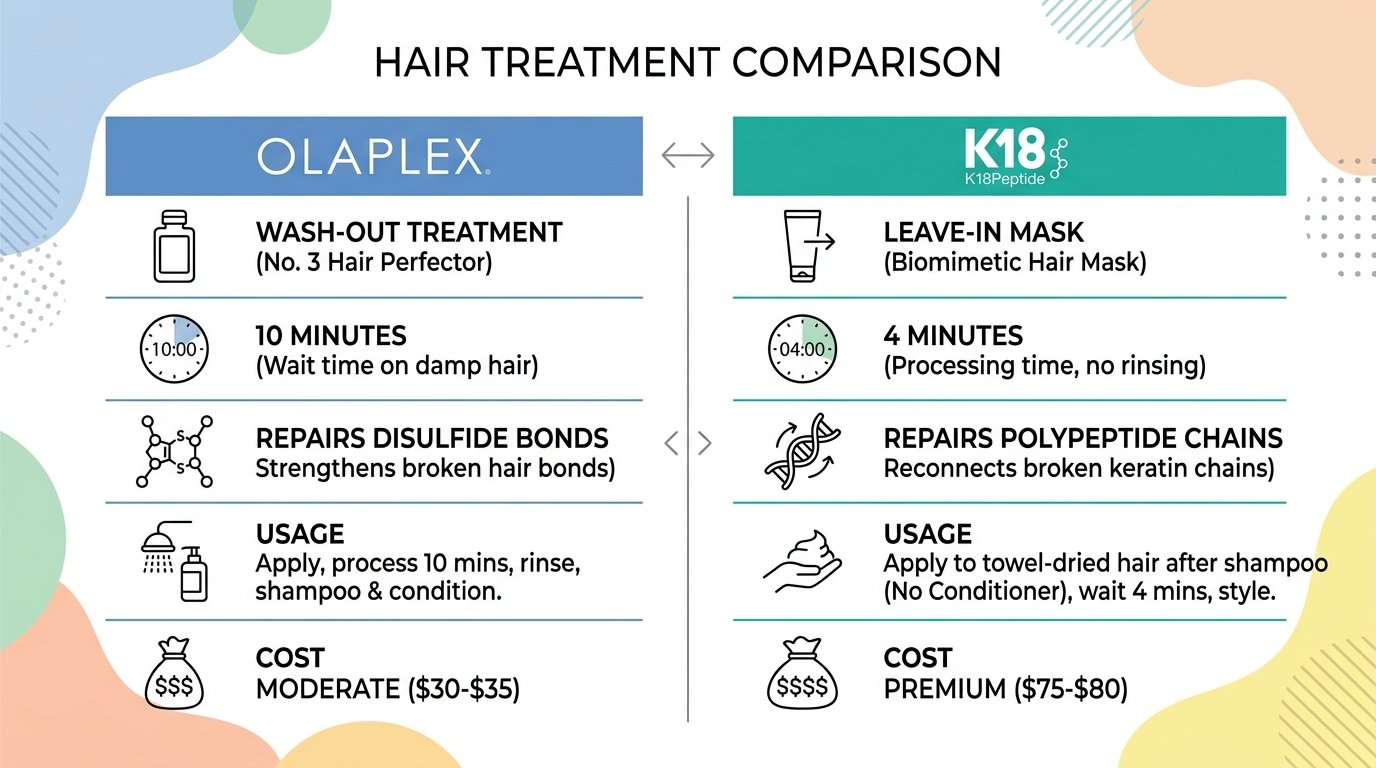
K18 vs Olaplex: The Ultimate Comparison Table
If you are a visual learner trying to decide between K18 vs Olaplex, here is the definitive breakdown.
| Feature | Olaplex (No. 3) | K18 (Leave-In Mask) |
|---|---|---|
| Main Technology | Bis-Aminopropyl Diglycol | Patented K18Peptide™ |
| Target Area | Disulfide Bonds (Horizontal) | Polypeptide Chains (Vertical) |
| Application Time | 10 to 45 Minutes | Exactly 4 Minutes |
| Usage Method | Pre-Shampoo (Wash Out) | Post-Shampoo (Leave In) |
| Conditioner Use | Required afterwards | Strictly Avoided |
| Price Point | ~$30 for 100ml | ~$75 for 50ml |
| Best For | Severe chemical damage prevention | Extreme breakage and time-saving |
Step-by-Step Guide: How to Use Olaplex Correctly
To get the best results in the K18 vs Olaplex showdown, you must use the products correctly. Many people misuse Olaplex and claim it doesn’t work.
- Dampen Hair: Olaplex needs water to travel into the hair shaft. Apply to unwashed, towel-dried, damp hair. (If your hair is caked in heavy styling gels or dry shampoo, do a light shampoo first, then apply).
- Apply Generously: Apply a generous amount from scalp to ends. Comb it through with a wide-tooth comb to ensure every strand is coated.
- The Waiting Game: Leave it on for a minimum of 10 minutes. For severe damage, leave it on for 45 to 90 minutes. (Leaving it overnight is not necessary as it stops working once the hair dries).
- The Wash Out: This is crucial. You MUST shampoo and condition your hair normally afterward. Olaplex is NOT a leave-in conditioner.
Step-by-Step Guide: How to Use K18 Correctly
Using K18 incorrectly is the number one reason for bad reviews in the K18 vs Olaplex debate. You must follow the “Less is More” rule.
💡 Editor’s Tip: “The first time I used K18, I used three huge pumps because my hair is so thick. It left my hair feeling sticky and rigid! You truly only need ONE pump. Rub it vigorously between your hands until it turns into a thick white paste, then apply it. It feels like nothing is in your hair, but trust me, it’s working.”
- Shampoo Only: Wash your hair with a clarifying shampoo to remove all product buildup. DO NOT apply conditioner. (Conditioner coats the cuticle in silicone, blocking the K18 peptide from entering the hair).
- Towel Dry: Gently squeeze the excess water out with a microfiber towel until the hair is just damp.
- Activate the Product: Pump 1 to 2 pumps of K18 into your palms. Rub your hands together vigorously for 10 seconds until the clear liquid turns into a thick, opaque white cream.
- Apply: Distribute evenly from the ends of your hair up to the roots.
- The 4-Minute Wait: Do absolutely nothing for 4 minutes. Do not comb it, do not apply other styling products. Let the peptide penetrate.
- Style: After 4 minutes, you can apply your normal heat protectants or oils and blow-dry as usual. Do not rinse the K18 out.
Can You Use K18 and Olaplex Together?
Yes! In fact, using both is considered the “God Mode” of hair repair for people with severely chemically compromised hair (like transitioning from black box dye to platinum blonde).
However, you do not use them on the same day.
- The Rotation Method: Use Olaplex No. 3 on a Sunday when you have 45 minutes for a deep “everything shower.” Use K18 on a Wednesday morning when you are rushing to get to work but still need to treat your hair.
- By combining them, you are ensuring that both the disulfide bonds (Olaplex) and the polypeptide chains (K18) are fully fortified.
Myths vs. Facts: Debunking Hair Repair Rumors
To truly settle the K18 vs Olaplex debate, we must debunk the viral misinformation spreading on social media.
Myth 1: Olaplex causes hair loss.
Fact: False. Olaplex is formulated to repair bonds, not interact with the follicle at the scalp level. Hair loss is a complex medical issue related to hormones, stress, or scalp inflammation. According to the American Academy of Dermatology (AAD), product buildup can cause breakage, but bond builders do not cause alopecia.
Myth 2: K18 is just a protein treatment.
Fact: False. K18 is a peptide treatment. Traditional protein treatments (like Keratin masks) use large molecules that coat the outside of the hair, which can make low-porosity hair feel stiff and brittle (Protein Overload). K18’s biomimetic peptide is small enough to go inside the cortex, avoiding the brittle feeling.
Myth 3: You only need to use them once.
Fact: False. While K18 claims permanent repair of the chains, daily activities (sun exposure, brushing, flat irons, hot water) constantly create new damage. You must use these products continuously as part of a maintenance routine.
Myth 4: They replace the need for haircuts.
Fact: False. Neither product can permanently glue a severely split end back together. If the hair fiber is physically split in half like a Y-shape, the only cure is a sharp pair of scissors. These products prevent the split from traveling further up the shaft.
Frequently Asked Questions (FAQs)
Which one is better for virgin, uncolored hair?
If your hair has never been dyed or heat-styled, you likely do not have broken disulfide bonds. Neither product will offer dramatic results. However, if you have mechanical damage from aggressive brushing, K18 is slightly better at improving overall resilience.
Why is K18 so expensive?
K18 is highly concentrated. While a $75 bottle seems steep, you only use 1-2 pumps per wash. A single 50ml bottle often lasts 4 to 6 months, bringing the “cost per use” very close to Olaplex.
Can I use Olaplex No. 3 as a leave-in conditioner?
Absolutely not. Olaplex No. 3 must be washed out. Leaving it on the hair and allowing it to dry can lead to severe product buildup, which blocks moisture and causes the hair to snap.
Does K18 work on fine, thin hair?
Yes, K18 is arguably better for fine hair than traditional heavy masks. Because it requires you to skip conditioner, it leaves fine hair feeling incredibly light, airy, and voluminous without weighing it down with heavy silicones.
How often should I use them?
- Olaplex: 1 to 2 times a week for severely damaged hair.
- K18: Use for 6 consecutive washes initially to build the peptide foundation. After that, use it once every 3 to 4 washes for maintenance.
Final Verdict: Which One Should You Buy in 2026?
The conclusion of the K18 vs Olaplex showdown is that both products are phenomenal feats of cosmetic chemistry, but they serve slightly different lifestyles and damage types.
- Buy Olaplex No. 3 if: You have a dedicated self-care day, you love the feeling of using a traditional thick conditioner afterward, you have curly hair that has lost its pattern, and you prefer a more budget-friendly initial purchase.
- Buy K18 Leave-In Mask if: You are extremely busy and need a 4-minute miracle, your hair is severely chemically fried to the point of breaking off, you have fine hair that gets weighed down easily, and you are willing to make a higher upfront investment.
Your hair is your crown. Stop cutting off inches of growth every month due to breakage. By investing in the science of bond building, you can finally achieve the long, thick, healthy hair you deserve.
To further protect your newly repaired hair from mechanical damage while you sleep, it is absolutely vital to upgrade your bedding. Read our comprehensive guide on Silk vs Satin Pillowcase Benefits to ensure you aren’t ripping out your hair on rough cotton every night. Additionally, if you want to stimulate new growth from the scalp level, check out our clinical comparison of Minoxidil vs Rosemary Oil.
Disclaimer: This content on Mediglamhub includes affiliate reviews. Prices and formulations are subject to change. Always consult with a licensed cosmetologist for severe chemical hair damage.